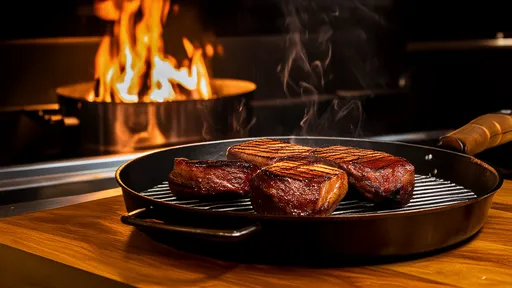
The sizzle of meat hitting a hot grill is more than just an auditory delight—it’s the sound of chemistry in action. At the heart of this transformation lies the Maillard reaction, a complex interplay of heat, amino acids, and reducing sugars that gives grilled meat its characteristic flavor, aroma, and color. When it comes to charcoal-grilled barbecue, the thermal radiation field generated by burning embers plays a pivotal role in optimizing this reaction. Unlike gas grills, which rely primarily on convection, charcoal fires emit intense infrared radiation that penetrates the meat’s surface, creating a unique efficiency in Maillard kinetics.
The Science of Charcoal’s Radiant Heat
Charcoal burns at temperatures exceeding 500°C (932°F), producing a robust thermal radiation field. This infrared energy doesn’t just cook the meat; it excites molecules at the surface, accelerating the Maillard reaction. The reaction, named after French chemist Louis-Camille Maillard, occurs when heat causes amino acids and sugars to rearrange into hundreds of new compounds. These compounds are responsible for the deep umami, roasted notes, and golden-brown crust that define premium barbecue. The radiant heat from charcoal is particularly effective because it delivers energy evenly, minimizing hot spots that can lead to uneven browning or charring.
Why Charcoal Outperforms Gas for Maillard Efficiency
Gas grills heat meat primarily through convection—hot air transferring energy to the surface. While effective for cooking, this method lacks the penetrating power of infrared radiation. Charcoal, on the other hand, emits a broad spectrum of infrared wavelengths, some of which are absorbed more efficiently by proteins and sugars. This absorption triggers the Maillard reaction at a faster rate, allowing for better crust formation without overcooking the interior. Additionally, the smoldering wood chunks or chips often added to charcoal fires release volatile organic compounds that further enhance flavor development, something gas flames simply can’t replicate.
The Role of Ember Positioning and Airflow
Mastering the Maillard reaction over charcoal isn’t just about heat intensity—it’s about control. The arrangement of embers and the management of airflow dictate the thermal radiation field’s consistency. A two-zone fire, where coals are piled on one side of the grill, allows for both direct radiant heat and indirect convection. This setup lets cooks sear meat over the embers to initiate the Maillard reaction, then move it to the cooler side to finish cooking gently. Adjusting vents to regulate oxygen flow ensures the coals burn cleanly and maintain steady radiation, preventing flare-ups that can scorch the meat and disrupt flavor development.
Cultural and Culinary Implications
Beyond the science, charcoal grilling carries cultural weight. From Korean gogigui to Argentine asado, the use of radiant heat from wood or charcoal is a tradition refined over centuries. These methods aren’t just about nostalgia; they’re rooted in the observable superiority of radiant heat for flavor. Modern chefs and food scientists are now quantifying what pitmasters have long known empirically: that the Maillard efficiency of charcoal is unmatched. As barbecue enthusiasts experiment with different woods, charcoal types (lump vs. briquettes), and grill designs, the pursuit of the perfect crust continues to evolve, blending ancient techniques with contemporary understanding.
Future Innovations in Thermal Radiation Cooking
While charcoal remains a gold standard, technology is catching up. Infrared grills, designed to mimic the radiant heat of charcoal, are gaining traction. However, purists argue that they still lack the nuanced flavor contributions of smoldering wood. Meanwhile, research into precise heat modulation—such as adjustable ceramic emitters or hybrid grill systems—aims to give cooks even greater control over Maillard kinetics. Yet, for now, the primal allure of charcoal, with its crackling embers and smoky perfume, remains the most effective way to harness thermal radiation for culinary perfection.
The art of caramelization is as much science as it is culinary craft. When sugar transforms under heat, it undergoes a complex series of chemical reactions that yield rich flavors and deep colors—a process both revered and feared by chefs and confectioners alike. Understanding the temperature thresholds during this transformation isn’t just academic; it’s the difference between a perfectly amber glaze and a bitter, burnt disaster.
At its core, caramelization is the pyrolysis of sugar. As sucrose breaks down, it produces hundreds of new compounds, each contributing to flavor, aroma, and color. The process begins subtly around 320°F (160°C), where sugars start to melt and turn pale gold. This is the stage where delicate notes of butter and cream emerge—ideal for light sauces or glazes. But venture beyond 340°F (171°C), and the sugar takes on a more assertive personality. The color deepens to a warm amber, and flavors grow more complex, with hints of toasted nuts and dried fruit.
The danger zone arrives swiftly. Around 356°F (180°C), the sugar’s transformation accelerates. What was once a controlled reaction can quickly spiral into chaos. The line between a richly flavored caramel and an acrid, inedible mass is thin. Professional kitchens rely on precision thermometers, but even then, external factors—humidity, the type of pan, or the heat source—can skew results. A stainless steel pan distributes heat differently than copper, and a gas flame reacts faster than induction. These variables demand vigilance.
One of the lesser-discussed challenges is the sugar’s residual heat. Even after removing the pot from the burner, the molten mass continues to cook. This thermal carryover can push the caramel past its intended stage if not accounted for. Seasoned pastry chefs often employ the "cold bowl" technique—transferring the hot sugar to a chilled container to halt the reaction. Others add a splash of cream or butter, not just for flavor, but to rapidly lower the temperature.
The color spectrum of caramel is a visual language unto itself. A light honey hue suggests mild sweetness, while a deep mahogany signals intensity. But color can deceive. Due to the Maillard reaction—often confused with caramelization—proteins in dairy or other additives may darken the mixture prematurely. Pure sucrose caramelizes differently than fructose or glucose, which burn at lower temperatures. This is why many recipes call for a combination of sugars, balancing stability with flavor development.
Industrial applications take these principles to extremes. In commercial candy production, sugar is often heated to 375°F (190°C) or higher, requiring specialized equipment to prevent scorching. The margin for error is razor-thin; a few degrees can alter texture, viscosity, and shelf life. Some large-scale manufacturers use computerized systems to monitor the sugar’s browning in real time, adjusting heat inputs dynamically. Yet even with technology, the human element remains critical. Experienced technicians still taste and visually inspect batches, trusting their senses alongside sensors.
For home cooks, the stakes may be lower, but the frustration is real. A failed caramel can derail an entire dessert. The key lies in patience and preparation. Using a heavy-bottomed pan to prevent hot spots, avoiding stirring once the sugar dissolves (which can cause crystallization), and having an ice bath ready as an emergency brake—all这些小技巧 can mean the difference between success and starting over. And sometimes, embracing imperfection leads to discovery. A slightly overdone caramel might not work for flan, but it could elevate a savory barbecue sauce with its smoky depth.
Beyond the kitchen, caramelization’s principles find unexpected applications. Coffee roasters apply similar temperature awareness when developing beans’ flavor profiles. Brewers manipulate sugar stages in beer-making for varying degrees of malt sweetness. Even pharmaceutical companies study caramelization to prevent sugar-based medications from degrading during sterilization. The humble process of browning sugar resonates across disciplines, a testament to its fundamental role in chemistry and culture.
Mastering caramel is as much about respecting its volatility as it is about controlling it. There’s a reason professional pastry chefs speak of caramel with a mix of reverence and wariness. It obeys the laws of thermodynamics with brutal honesty, offering no second chances once the line is crossed. Yet when handled with knowledge and care, it transforms the ordinary into the extraordinary—a alchemy of heat and sugar that continues to captivate and challenge.
By /Jul 24, 2025
By /Jul 24, 2025
By /Jul 24, 2025
By /Jul 24, 2025
By /Jul 24, 2025
By /Jul 24, 2025
By /Jul 24, 2025
By /Jul 24, 2025
