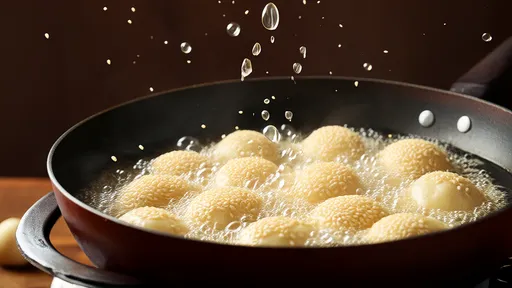
The process of frying maqiu, or Chinese sesame balls, is a fascinating interplay of heat transfer, moisture dynamics, and structural transformation. These golden-brown delicacies, with their crisp exterior and hollow, airy interior, undergo a remarkable expansion during frying that has intrigued both chefs and food scientists alike. The expansion mechanism is governed by a complex set of physical and chemical reactions that occur when the dough encounters hot oil.
At the heart of maqiu's expansion lies the unique composition of its dough. Typically made from glutinous rice flour, water, and sugar, the dough possesses a viscoelastic structure capable of trapping gases. When submerged in hot oil, the surface rapidly dehydrates and forms a semi-rigid crust while the interior remains moist. This crust formation is crucial as it creates a contained environment where internal pressure can build, setting the stage for the dramatic inflation that follows.
The temperature gradient between the oil and dough initiates multiple simultaneous processes. As the dough heats, moisture near the surface evaporates quickly, creating tiny steam bubbles. Meanwhile, the sugar content begins to caramelize at the surface, contributing to both color development and structural integrity. The most critical phase occurs when the internal temperature reaches approximately 60-70°C, causing the starch granules in the rice flour to gelatinize. This gelatinization transforms the dough's matrix into an elastic membrane capable of stretching without immediate rupture.
Water plays a dual role as both protagonist and antagonist in this culinary drama. While its conversion to steam provides the primary expanding force, excessive moisture can lead to premature rupture or uneven expansion. Skilled makers often adjust dough hydration carefully, finding the precise balance where enough water exists to generate sufficient steam, but not so much that it compromises the dough's structural stability during the critical expansion phase.
The oil itself acts as more than just a heat transfer medium. Its temperature must be carefully controlled—typically maintained between 160-180°C—to allow gradual expansion without burning the exterior. The hot oil facilitates rapid heat penetration while simultaneously promoting the Maillard reaction and caramelization at the surface. These reactions not only develop flavor but also create a semi-permeable barrier that regulates moisture loss and internal pressure buildup.
An often overlooked aspect of maqiu expansion involves the microscopic air pockets incorporated during dough mixing. These pre-existing gas nuclei serve as initiation sites for bubble growth when heating begins. As steam generation commences, these micro-bubbles expand, coalesce, and migrate upward through the viscous dough matrix. The spherical shape of the maqiu encourages even distribution of these expanding gases, resulting in the characteristic hollow center surrounded by a web of thin, crispy strands.
The final stages of frying present a delicate equilibrium. As internal pressure increases, the dough membrane stretches thinner while continuing to brown at the surface. The skilled fryer recognizes the precise moment when the maqiu has reached maximum expansion—typically indicated by a slight floating elevation in the oil and a distinctive hollow sound when tapped. Removing the maqiu at this perfect juncture ensures optimal texture: a shatteringly crisp shell giving way to an ethereal, air-filled interior with just the right chewiness from the glutinous rice flour.
Modern food science has revealed that the expansion phenomenon follows principles similar to those in polymer science and rheology. The glutinous rice flour's amylopectin molecules, when heated in the presence of water, undergo structural changes that allow the dough to behave like a thermoplastic material. This unique property enables the simultaneous hardening of the exterior while maintaining enough plasticity in the interior to accommodate expansion—a duality rarely found in other fried foods.
Commercial production of maqiu has adapted these scientific principles to industrial scales, employing precisely controlled fryers with multiple temperature zones. These systems mimic the traditional artisan's technique of initially frying at lower temperatures to allow gradual expansion, followed by higher temperatures to set the structure and achieve perfect coloration. Such technological adaptations demonstrate how ancient culinary wisdom and modern food engineering can converge to perfect a centuries-old treat.
The cultural significance of maqiu's expansion extends beyond mere physics. In Chinese tradition, the ball's inflation symbolizes prosperity and fullness, making it a staple at celebratory events. This cultural dimension adds another layer of meaning to the meticulous process—the cook's skill in achieving perfect expansion becomes not just a culinary achievement but a symbolic gesture of goodwill and abundance.
Recent innovations have explored variations on the traditional formula, incorporating ingredients like baking powder or yeast to supplement steam-driven expansion. While purists may argue these additions alter the authentic texture, they demonstrate the ongoing evolution of this ancient technique. Food scientists continue to study maqiu expansion as a model system for understanding more complex foam-based food structures, proving that this humble street food offers lessons reaching far beyond its crispy surface.
Ultimately, the perfect maqiu represents a harmonious convergence of ingredient science, thermal dynamics, and culinary intuition. Each step in its preparation—from dough formulation to frying technique—contributes to that magical moment when a dense ball of dough transforms into a light, crispy sphere. This transformation, governed by fundamental principles of physics and chemistry, remains one of the most visually dramatic phenomena in all of culinary arts, a testament to the ingenuity of traditional food preparation methods.
The global mango industry faces persistent challenges in maintaining fruit quality during storage and transportation. Among the most pressing issues is the rapid ripening and subsequent spoilage caused by ethylene gas, a natural plant hormone that accelerates maturation. Traditional preservation methods often fall short, but recent innovations in activated carbon technology offer promising solutions for extending mango shelf life while reducing post-harvest losses.
Activated carbon has emerged as an unexpected ally in the battle against premature mango ripening. This highly porous material, typically associated with water filtration and air purification, demonstrates remarkable ethylene adsorption capabilities when properly modified. Researchers have discovered that specific surface treatments can enhance activated carbon's affinity for ethylene molecules, creating an effective scavenger system that removes this ripening trigger from storage environments. Unlike chemical inhibitors that may alter fruit flavor, activated carbon operates through purely physical adsorption, preserving the mango's natural taste profile.
The science behind this application reveals fascinating details about molecular interactions. Activated carbon contains an extensive network of micropores that create enormous surface areas - often exceeding 1,000 square meters per gram. When mangoes respire and release ethylene during storage, these pores trap the gas molecules through weak van der Waals forces. Advanced formulations now incorporate metal-organic frameworks (MOFs) within the carbon structure to improve selectivity for ethylene over other atmospheric gases. This targeted approach maintains optimal storage conditions without creating oxygen-deficient environments that could harm fruit quality.
Practical implementations in commercial settings have demonstrated significant benefits. Packing houses in major mango-producing regions now integrate activated carbon sachets into shipping containers and storage facilities. These breathable packets, typically placed between fruit layers in cartons, continuously remove ethylene throughout the supply chain. Field tests show that treated mangoes maintain firmness 30% longer than control groups while delaying color changes associated with over-ripening. The technology proves particularly valuable for sea shipments, where extended transit times traditionally resulted in substantial spoilage before reaching distant markets.
Beyond ethylene control, activated carbon offers secondary advantages that enhance its value proposition. The material naturally absorbs volatile organic compounds that contribute to off-flavors, creating cleaner storage atmospheres. Some formulations incorporate antimicrobial agents that further protect against fungal growth. Unlike single-use chemical absorbers, certain activated carbon products can be regenerated through thermal treatment, offering cost-effective reuse potential for large-scale operators. These multifaceted benefits position the technology as a comprehensive solution rather than just an ethylene management tool.
The environmental profile of activated carbon applications warrants particular attention in today's sustainability-focused market. As a carbon-based material derived from renewable sources like coconut shells or bamboo, it aligns with circular economy principles. Modern production methods have reduced energy requirements for activation processes, lowering the overall carbon footprint. When compared to synthetic alternatives, activated carbon presents fewer end-of-life concerns as spent material can be safely composted or utilized as soil amendment. This eco-friendly characteristic resonates strongly with retailers and consumers increasingly demanding sustainable supply chain practices.
Commercial adoption nevertheless faces certain implementation challenges. Optimal loading ratios - the amount of activated carbon required per kilogram of fruit - vary significantly based on mango variety, ripeness stage at harvest, and expected storage duration. Humidity control becomes crucial, as excessive moisture can reduce adsorption efficiency. Some exporters report difficulties in achieving uniform ethylene removal throughout large containers, prompting development of improved distribution systems for the absorbent material. These practical hurdles highlight the need for customized solutions rather than one-size-fits-all approaches.
Looking ahead, researchers are exploring next-generation composites that could revolutionize mango preservation. Hybrid materials combining activated carbon with photocatalytic components show potential for continuous ethylene destruction rather than mere adsorption. Nano-engineered carbon structures promise tenfold increases in ethylene capture capacity. Smart packaging concepts integrate color-changing indicators that signal when absorbent materials require replacement. Such advancements could transform activated carbon from a passive scavenger into an active preservation system capable of dynamically responding to changing storage conditions.
The economic implications of widespread activated carbon adoption merit serious consideration. Post-harvest losses account for nearly 40% of mango production in some developing countries. Even modest extensions in shelf life can dramatically improve market access and reduce price volatility. Early adopters report 15-20% reductions in transport-related waste, translating to millions in annual savings for large exporters. As technology costs decrease through scaled production, activated carbon solutions are becoming accessible to smallholder farmers through cooperative purchasing models, potentially democratizing access to advanced preservation techniques.
Regulatory aspects present another dimension for industry attention. Unlike chemical treatments, activated carbon systems generally qualify as physical processing aids rather than food additives, simplifying compliance with international food safety standards. However, some importing countries require specific certifications for materials in direct contact with produce. The industry is responding by developing food-grade formulations with documentation trails meeting stringent EU and USDA organic program requirements. This regulatory-friendly position gives activated carbon an advantage over emerging chemical technologies facing longer approval timelines.
Implementation best practices are crystallizing as the technology matures. Leading exporters now combine activated carbon with precision temperature management for synergistic effects. The most successful operations conduct pre-shipment trials to determine ideal exposure durations - excessive ethylene removal can sometimes delay desired ripening at destination markets. Proper ventilation designs ensure uniform gas distribution while preventing moisture accumulation. These nuanced approaches demonstrate how simple materials can achieve sophisticated results when applied with scientific understanding and operational expertise.
The mango industry's embrace of activated carbon reflects broader trends in post-harvest innovation. As consumers reject synthetic preservatives and demand longer-lasting natural produce, physical intervention methods gain prominence. Activated carbon's simplicity, effectiveness, and sustainability position it as a bridge technology - solving immediate challenges while research continues on more advanced solutions. Its success may inspire similar applications for other ethylene-sensitive fruits, potentially transforming global produce supply chains. For now, this humble material is quietly revolutionizing how the world ships and stores one of its most beloved tropical fruits.
By /Jul 24, 2025

By /Jul 24, 2025
By /Jul 24, 2025
By /Jul 24, 2025
By /Jul 24, 2025
By /Jul 24, 2025
By /Jul 24, 2025

By /Jul 24, 2025
